
THE SCIENCE
OsteoStrong offers a highly effective, evidence-based musculoskeletal strengthening program that can be used in place of or to compliment pharmaceutical treatment and as a preventative protocol. Explore groundbreaking research and innovative technologies that drive our approach to strengthening bones and improving overall well-being.
WHAT IS OSTEOSTRONG?
OsteoStrong is a membership based Integrative Health and Wellness Center with a focus on Musculoskeletal Strengthening.
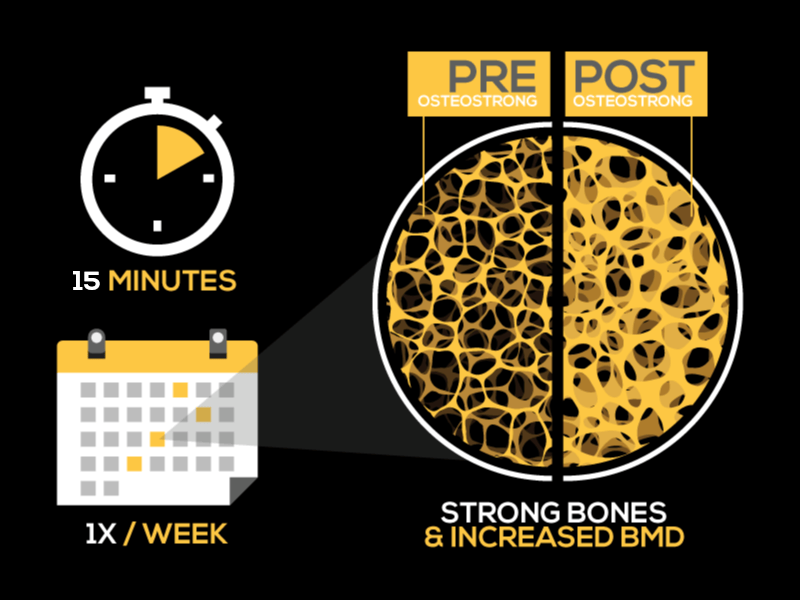
A four device circuit takes only 15 minutes once per week to complete. Under the direction of a skilled technician, users engage in a safe controlled movement on each device that results in a stimulus to the central nervous system triggering osteogenesis or new bone growth.
Each device provides instant biofeedback with a member’s impact emulation force exertion measured in pounds and multiples of body weight.
Data is recorded and a report is sent to the member detailing their progress at the conclusion of each session.
WE UNDERSTAND
Bisphosphonates are generally the first line of defense for patients diagnosed with osteoporosis. Unfortunately, the risk of other problems can make this a complicated decision.
Until now there were few exercise-based, non- pharmaceutical options that offered significant increases in bone density in a safe manner for even the most high-risk patients.
OsteoStrong offers a highly
effective, evidence-based musculoskeletal strengthening program that can be used in place of or to compliment pharmaceutical treatment and as a preventative protocol, especially for women going through menopause.
WHY IT WORKS
The greatest effect on bone strength and health is the result of high-impact activity, and hundreds of studies have confirmed this, even identifying the minimum dose of force required through bone as being over 4 times bodyweight in the hip joint .
As adults, exercises involving impact can increase risk of injury, therefore adults intentionally avoid impact and so even those who engage in regular exercise often fail to maintain bone health.
OsteoStrong utilizes a series of isometric musculoskeletal treatment devices utilizing high impact emulation, so that people can get the bone-building benefit of impact without the associated risks.
OsteoStrong increases bone density, improves balance and posture, and can even make you
STRONGER!
The OsteoStrong Effect - strength that leads to a greater healthspan
Skeletal Strength
Bone Density
Joint Strength
Balance
Posture
Pain Relief
Energy
Physical Freedom
15 MINUTES PER WEEK
While hard to believe, the four device circuit takes only 15 minutes once per week to complete. Under the direction of a skilled technician, users engage in a safe controlled movement on each device that results in a stimulus to the central nervous system triggering osteogenesis (new bone growth).
Click below to see how our bone building system, called Spectrum, really works.
CHANGES IN BONE DENSITY OVER A 12 MONTH PERIOD
CASE STUDIES
Study: Effective Brief, Low-impact, High-intensity Osteogenic Loading in Postmenopausal Osteoporosis
Summary: In conclusion, the study demonstrated that the Osteostrong intervention is a safe, brief method with a significant positive impact on the BMD and TBS of the lumbar spine, hip and femoral neck, in women with postmenopausal osteoporosis.
Published: 2025
Study: Axial Bone Osteogenic Loading-Type Resistance Therapy Showing BMD and Functional Bone Performance Musculoskeletal Adaptation Over 24 Weeks with Postmenopausal Female Subjects
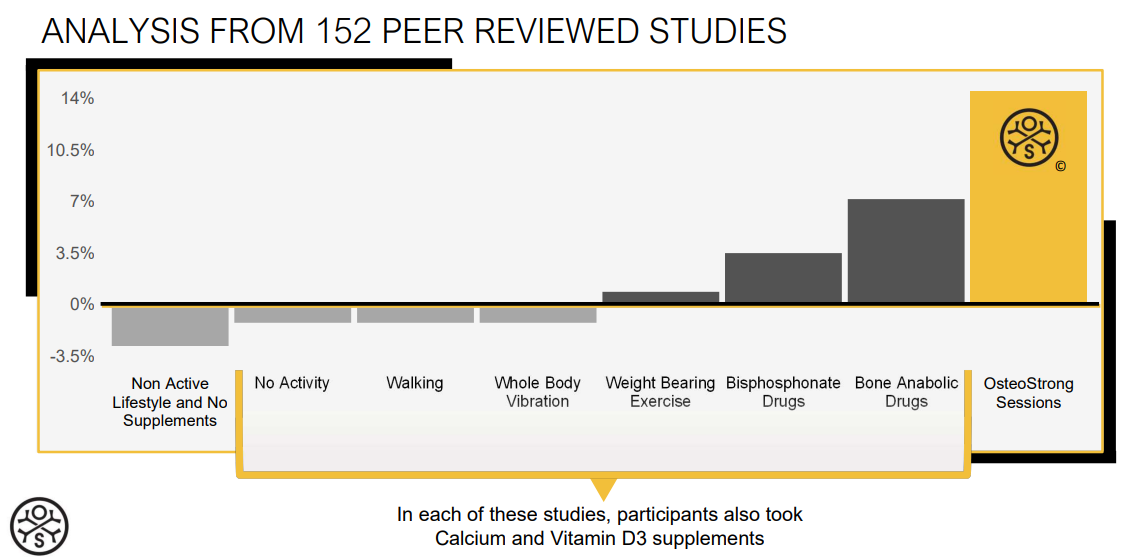
Summary: The DXA subgroup saw BMD (g/cm2) increases of 14.9% (+/- 11.5% SD) in the hip, and 16.6% (+/- 12.2% SD) in the spine.
Published: 2021
Study: World Congress on Osteoporosis, Osteoarthritis and Musculoskeletal Diseases (WCO-IOFESCEO 2015): Non-sponsored Symposia Abstract
Summary: These data present a new metric of functional bone performance, and an opportunity to consider a supplementary treatment option for ambulatory individuals with low BMD.
Published: 2015
Study: Habitual Levels of High, But Not Moderate or Low, Impact Activity Are Positively Related to Hip BMD and Geometry
Summary: We found that >4.2g impacts were positively related to hip BMD, suggesting that high-impact activities produce BMD gains of the lower limb. In contrast, impacts below this threshold may have little benefit, suggesting that strains associated with moderately high-impact activities such as jogging have relatively little effect on BMD.
Published: 2012
Study: Intensity of exercise is associated with bone density change in premenopausal women
Summary: The study showed that
physical activity including accelerations of 3.9 g or more was positively associated with BMD changes of the proximal femur, whereas activity at lower intensity did not correlate with BMD changes. The findings suggest that the effect of impact exercise is site-specific and that the optimal intensity may vary between different bone sites
Published: 2021
Study: A small amount of precisely measured high-intensity habitual physical activity predicts bone health in pre- and post-menopausal women in UK Biobank
Summary: Brief bursts of high-intensity physical activity relevant to bone health can be captured by applying bone-specific thresholds of intensity to raw tri-axial accelerations averaged over 1-second epochs.
Published: 2017
Study: Static tensional forces increase osteogenic gene expression in
three-dimensional periodontal ligament cell culture
Summary: Static tensional forces significantly increased expression of osteogenic markers including alkaline phosphatase, collagen, and VEGF. Genes up-regulated by static tensional force are related to osteogenic processes such as matrix synthesis and angiogenesis.
Published: 2009
Study: The Effects of Axial Bone Osteogenic Loading-Type Resistance Exercise on Adults with Risk of Moderate-Metabolic Dysfunction
Summary: We saw a statistically significant reduction in the HbA1c measures of subjects with the 24 weeks/sessions of OL. The significant changes in blood glucose management occurred without significant body weight changes, or changes in BMI. This can indicate change in density of muscle cells from a myofibril standpoint, resulting in greater ability for insulin reception.
Published: 2015
Study: Mechanical regulation of bone remodeling
Summary: Mechanical forces are indispensable for bone homeostasis; skeletal formation, resorption, and adaptation are dependent on mechanical signals, and loss of mechanical stimulation can therefore significantly weaken the bone structure, causing disuse osteoporosis and increasing the risk of fracture.
Published: 2022